The Padel Clash Elo, explained simply
A playing-level rating that starts from your FFT ranking, then moves after every official tournament played on Padel Clash, according to the gap between the expected and the actual result. Here is exactly how it is calculated.
Free, private by default, no password
An expected result, an actual result, and the gap between them
As in chess, Elo is a relative rating: it does not count your wins, it measures whether you do better or worse than expected against your opponents. The Padel Clash Elo follows the Glicko-2 method, a version of Elo that accounts for uncertainty.
Before the match, the two pairs' Elo give each side's chances: a pair 100 points above the other has about a 63% chance of winning
After the match, the expected result is compared with the actual one: doing better than expected moves you up, doing worse moves you down
The actual result is your share of the games, not just the win: 6-4 6-4 is 12 games out of 20, or 60%. A super tie-break counts as one game
Beating a stronger pair earns a lot, beating a weaker one earns little, and a narrow loss to a stronger pair can even move you up
Your FFT ranking, converted into Elo
At your first counted tournament, your Elo starts from your FFT ranking: 1900 − 200 × log₁₀(rank). After that, your matches do the talking.
No. 100 ≈ 1500, no. 1,000 ≈ 1300, no. 10,000 ≈ 1100: going from 100th to 10th counts as much as from 10,000th to 1,000th
With no FFT ranking, you start at 950 with a wide margin (± 350): if you are stronger than that, you climb fast
Ranked, you start at ± 200: the FFT ranking is trusted, but only partly
The Elo always stays between 600 and 2600
Your pair is worth a little more than the average
In padel, the stronger player covers more of the court. A pair's strength is therefore the average of its two Elo, plus 5% of the gap between them.
Two players at 1500: a 1500 pair. A 1700 and a 1300: 1500 + 5% × 400 = 1520
The expected result compares your pair with the opposing pair: winning alongside a much stronger partner is less impressive, and that is taken into account
Each player then moves according to their own ± margin: the less-known of the two moves most, so two partners do not always move by the same amount
A player with no licence counts in their pair's strength, and so in their opponents' calculation, but has no Elo
A 6-4 6-4 win against a 1400 pair
You are at 1350 ± 80, your partner at 1250 ± 150. Opposite, two players at 1400 ± 80. A three-set match (format A), which counts in full.
1. Your pair's strength
(1350 + 1250) ÷ 2 + 5% × 100 = 1300 + 5 = 1305
2. The expected result
1305 against 1400: 38% for your pair
Formula: 1 ÷ (1 + 10^(−g × (1305 − 1400) ÷ 400)). The factor g, just below 1, accounts for both pairs' ± margins: the more uncertain, the more cautious the prediction.
3. The actual result
6-4 6-4: 12 games out of 20 = 60%
4. The gap
60% − 38% = +22 points: better than expected
5. The change
You: +8 · your partner: +25 · each opponent: −8
Same gap, not the same change: your partner, less known (± 150), moves more than you (± 80), and their margin narrows to ± 139. This is the Glicko-2 update, run once for all the matches of the tournament.
And against a 1600 pair?
Your chances drop to 18%. Losing 5-7 5-7 (42% of the games) still earns you +9. Losing 1-6 1-6 (14% of the games): −1.
These numbers are computed by the Padel Clash engine itself, on a one-match tournament. Your card rounds the Elo and the ± margin to the nearest ten.
An uncertainty margin that narrows as you play
The number after ± on your card says how sure we are of your level. The smaller it is, the more reliable your Elo.
It starts at ± 200 if you have an FFT ranking, ± 350 otherwise, then shrinks with every counted tournament
It slowly grows again while you do not play, never above ± 350: a level from a year ago is less certain
While it is ± 120 or more, your Elo is marked "Provisional"
The bigger it is, the more your Elo moves each tournament: a newcomer finds their level fast, a regular moves less
One tournament, one update
All your matches in a tournament are calculated together, from the Elo everyone had before the first match.
No multiplier for the tournament's level: a P100 and a P1000 count the same. The strength of the pairs you face makes the difference
Longer matches weigh more: three sets (format A) 100%, two sets and a super tie-break (B) 90%, short sets (C, D) 70%, super tie-break only (E) 50%. Without the set detail, only the win counts, at half weight
The change is capped at 150 points per tournament, up or down
A tournament not linked to Moja, the FFT's sanctioning tool, counts at 85%
Only official tournaments played on Padel Clash
Your Elo is updated every night: a tournament is taken into account 1 to 2 days after its last score.
Official FFT tournaments (P25 to P2000) run on Padel Clash, where the organiser entered your licence. Not Americanos or casual tournaments
Finished tournaments: at least 70% of matches with a score, at least 4 pairs and a majority of licensed players. Test tournaments are left out
Walkovers (WO), retirements, disqualifications and unplayed matches do not count
A score corrected afterwards? The tournament is recalculated, along with every one that followed it
An indicative rating, not the FFT ranking
The Padel Clash Elo belongs to Padel Clash. It does not replace the official ranking and does not rank players one by one.
The FFT ranking adds up points by finishing place and tournament level; the Elo estimates your playing level from your matches
It only sees tournaments played on Padel Clash: if you mostly play elsewhere, it stays less precise
Private by default: only you see your Elo, until you create a link or an image to share
A shared link shows your first name and last initial, never your licence number or email, and you can turn it off whenever you like
Frequently asked questions
No. It is an indicative rating calculated by Padel Clash from the matches played in the app. It does not replace the FFT ranking and changes nothing in your FFT points, your seeding or your entries.
They do not measure the same thing. The FFT ranking adds up points by finishing place and the level of each sanctioned tournament. The Elo starts from your ranking, then only moves with your matches played on Padel Clash, compared with what the Elo predicted: playing well against stronger pairs moves it up, even without winning the tournament.
Because we still have few matches to go on: you are new to Padel Clash, you started unranked (± 350), or you have not played for a long time. It shrinks with every counted tournament; below ± 120, your Elo is no longer "Provisional".
Very little, and sometimes not at all. What counts is your share of the games compared with what was expected. In our example, a 1305 pair has only a 18% chance against a 1600 pair: losing 5-7 5-7 earns the ± 80 player +9, losing 1-6 1-6 costs them −1.
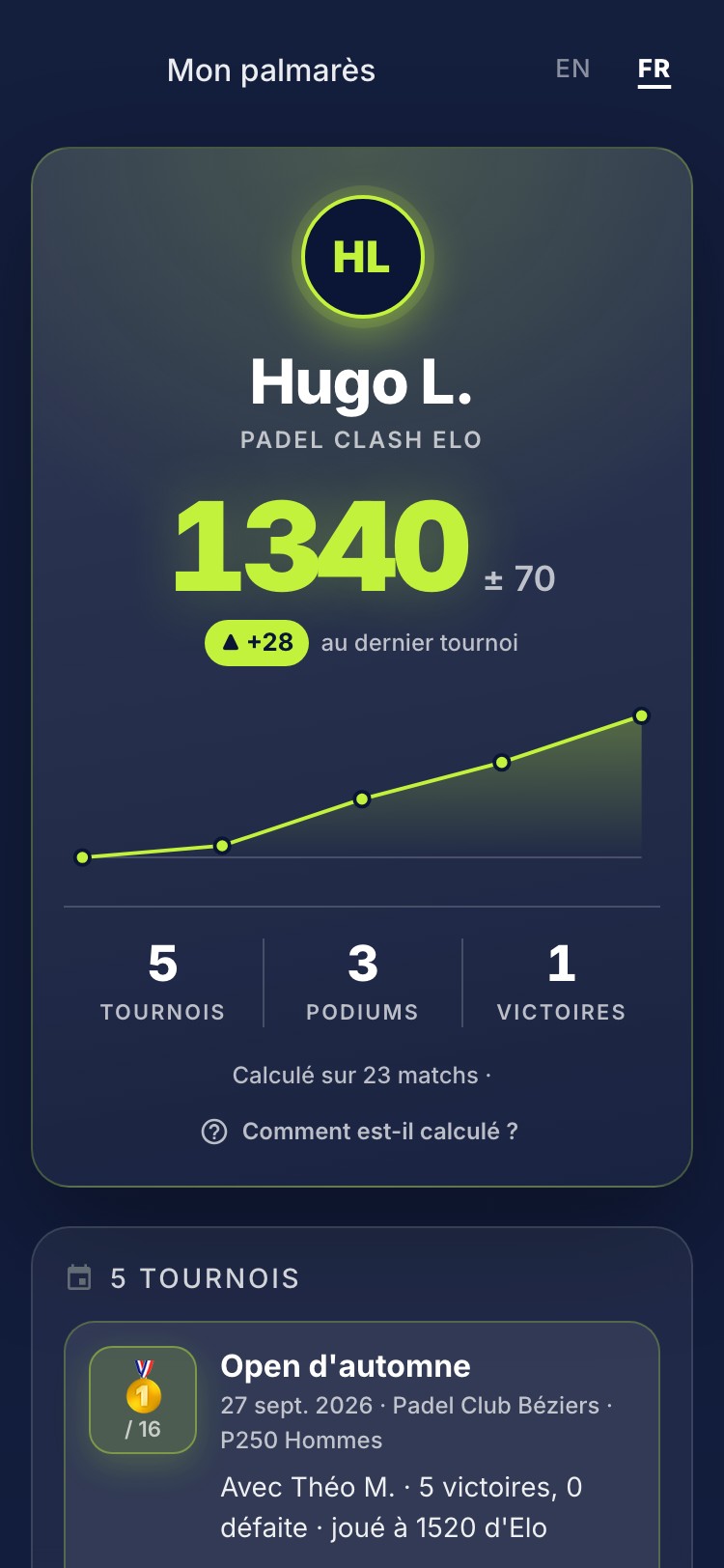
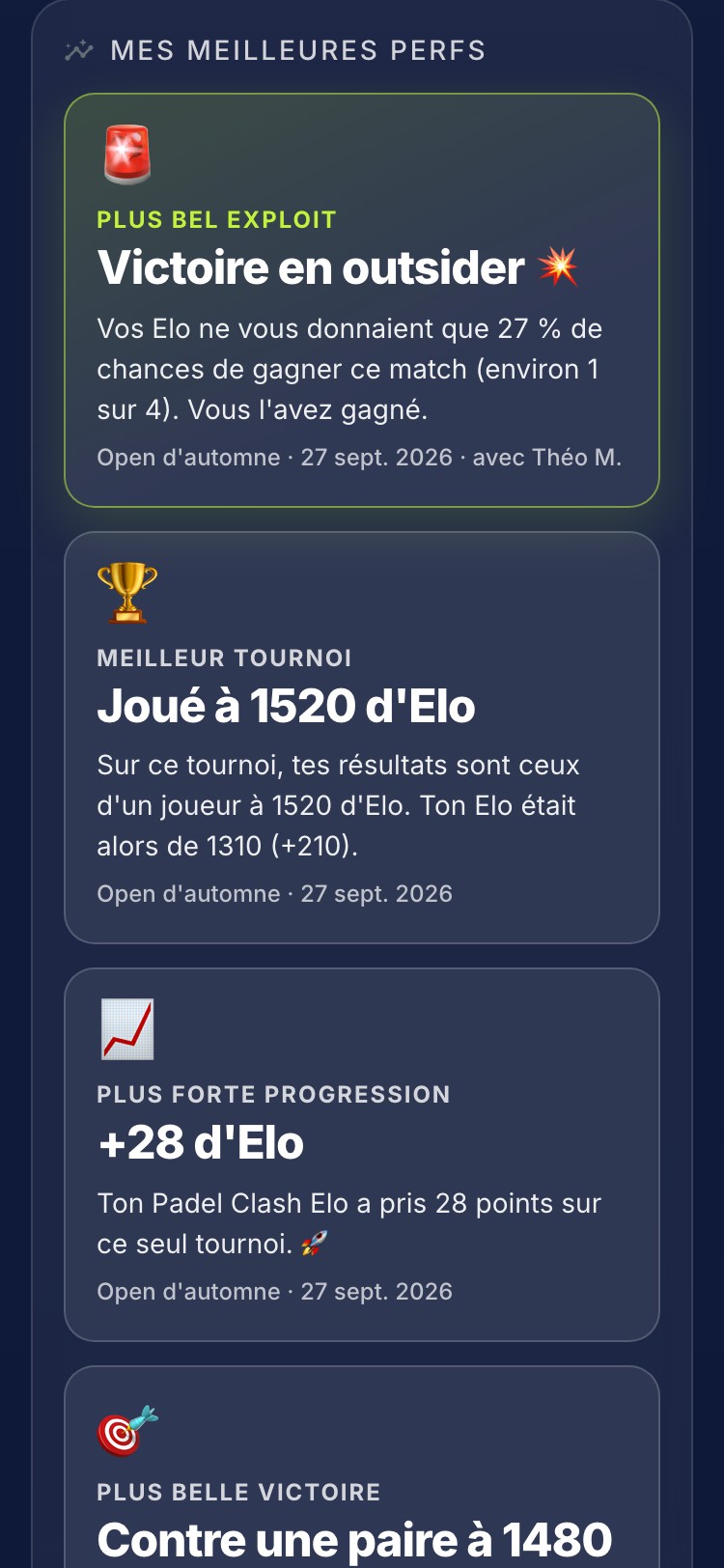
Open "My history" with your licence number and your email: a sign-in link arrives by email, no password. Your Elo appears after your first counted tournament, with its progress and your best performances.
Go further
Where is your Elo at?
Your licence number, your email, a sign-in link: your Padel Clash Elo, your tournaments and your best performances.